
Key Terminology in Medical Billing
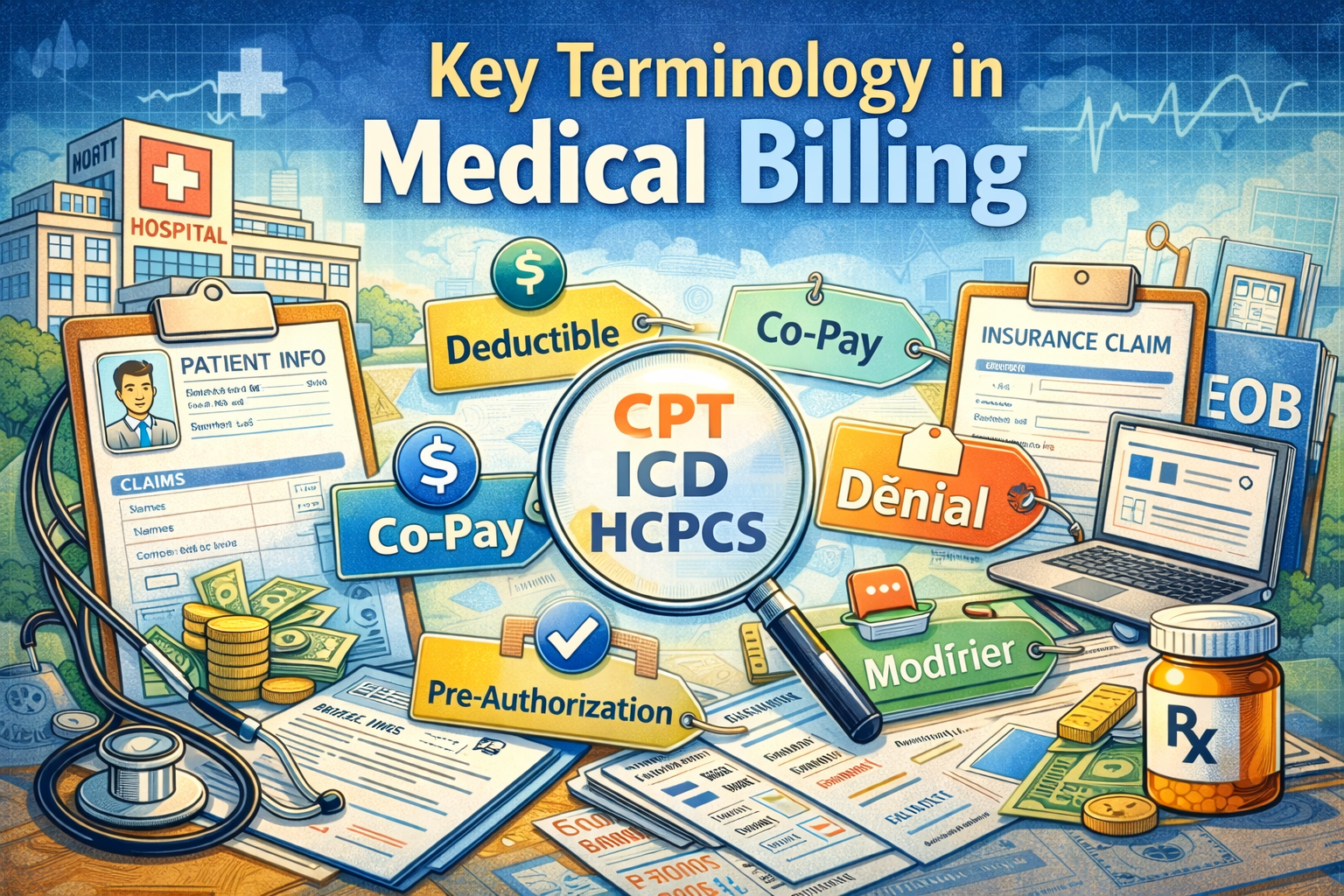
Understanding medical billing terminology is crucial for healthcare providers, billing teams, coders, and students preparing for a career in medical billing and coding. The medical billing process uses a standardized vocabulary that helps insurance companies, healthcare organizations, and government payers communicate clearly during the reimbursement cycle.
EOB vs ERA: How Insurance Payment Information Is Delivered
When an insurance company finishes processing a healthcare claim, they send details of how the payment was evaluated. Two documents play a major role in the insurance reimbursement process: the Explanation of Benefits (EOB) and the Electronic Remittance Advice (ERA).
Explanation of Benefits (EOB)
An EOB is a statement sent to patients and providers that explains how an insurance claim was handled. Although it is not a bill, it contains critical information such as the amount billed by the provider, the allowed amount according to the insurance contract, the amount paid by the insurance, and anything that the patient still owes. EOBs also provide detailed denial reasons, adjustment codes, and coverage limitations.
This document helps patients understand how their insurance plan applied their benefits and helps billers reconcile accounts.
Electronic Remittance Advice (ERA)
An ERA is the digital version of an EOB, sent directly to a provider’s billing system. ERAs speed up the payment posting process because the system can automatically match payments with their corresponding claims. ERAs reduce manual entry errors, improve accuracy, and make reconciliation faster.
In modern revenue cycle management, ERAs are essential for practices that want efficient billing operations and improved cash flow.
Keywords Used:
✔ insurance reimbursement
✔ Explanation of Benefits
✔ electronic remittance advice
✔ medical claim processing
✔ payment posting in medical billing
ICD-10, CPT, and HCPCS: The Coding Systems Behind Every Healthcare Claim
Medical billing cannot exist without medical coding, and three major code sets form the foundation of all claims. These standardized codes communicate the patient’s diagnosis, the procedures performed, and any items or services provided.
ICD-10 Codes: Explaining the Patient’s Diagnosis
ICD-10, short for International Classification of Diseases, Tenth Revision, contains thousands of diagnosis codes that describe medical conditions with a high level of detail. These codes answer the essential billing question: Why was the patient seen?
Insurance companies rely heavily on ICD-10 codes to determine medical necessity and decide whether a service qualifies for coverage. Accurate ICD-10 coding reduces denials and improves claim acceptance rates.
CPT Codes: Describing the Procedures Performed
CPT codes, or Current Procedural Terminology codes, describe what services the provider delivered. They include office visits, surgeries, imaging, lab tests, and almost every clinical service performed in outpatient settings.
CPT codes directly influence how much insurance pays, making them a core component of healthcare reimbursement. Special rules apply to certain CPT codes, including time-based requirements, global periods for surgical procedures, and payer-specific documentation guidelines.
HCPCS Codes: Identifying Supplies, Medications, and Equipment
HCPCS Level II codes cover medical supplies, injections, ambulance services, orthotics, durable medical equipment, and items not included in CPT codes. HCPCS codes are especially important for Medicare and Medicaid billing, but private carriers use them as well.
Without accurate HCPCS coding, claims for medical supplies or special services are often denied.
Keywords Used:
✔ ICD-10 diagnosis coding
✔ CPT procedure codes
✔ HCPCS Level II codes
✔ medical coding systems
✔ medical necessity documentation
Deductible, Copay, and Coinsurance: Understanding Patient Financial Responsibility
One of the most important — yet most confusing — concepts in medical billing is patient financial responsibility. Providers must understand these terms to bill patients correctly and avoid disputes.
Deductible
A deductible is the amount a patient must pay out-of-pocket before the insurance company begins covering services. Many insurance plans reset deductibles annually, and high-deductible health plans (HDHPs) often require patients to pay significant amounts upfront.
Incorrect deductible calculations are a leading cause of patient billing frustration, making accuracy essential for both billers and front-desk staff.
Copay (Copayment)
A copay is a fixed amount due at the time of service. It is typically associated with routine visits — such as primary care appointments or specialist consultations — and does not depend on the cost of the service.
Collecting copays during check-in is considered a best practice in modern front-end revenue cycle management.
Coinsurance
Coinsurance represents the percentage of the allowed amount that the patient must pay after the deductible has been met. For example, an 80/20 plan means the insurance pays 80% and the patient pays 20%.
Understanding coinsurance prevents incorrect billing and helps billing teams explain patient statements more clearly.
Keywords Used:
✔ patient financial responsibility
✔ deductible vs copay vs coinsurance
✔ medical billing terminology explained
✔ out-of-pocket costs
✔ insurance coverage rules
Clean Claim vs Denied Claim: The Difference Between Fast Payment and Delayed Revenue
A healthcare provider’s revenue cycle depends heavily on whether claims are clean or denied. These two terms determine how quickly practices get paid and how much work the billing team must complete to recover lost revenue.
Clean Claim
A clean claim is a claim submitted with complete, accurate, and error-free information. It meets all payer requirements and passes through clearinghouse edits without issues. Clean claims are processed quickly and paid on time — often within days for electronic submissions.
A high clean-claim rate is the strongest indicator of an efficient medical billing process.
Denied Claim
A denied claim is a claim rejected by the insurance company after processing because of an error, missing information, invalid coding, or lack of eligibility. Denied claims do not get paid unless corrected and resubmitted.
Some denials are preventable, while others require appeals with additional documentation.
Improving clean-claim rates and reducing denied claims are core strategies for stronger revenue cycle management.
Keywords Added:
✔ clean claim definition
✔ denied claim reasons
✔ medical claim denial management
✔ revenue cycle performance
✔ claim resubmission and appeals
Conclusion:
Mastering key medical billing terminology is essential for anyone working in healthcare administration, revenue cycle management, or medical coding. Understanding concepts such as EOB, ERA, ICD-10, CPT, HCPCS, deductible, copay, coinsurance, and the difference between a clean claim and a denied claim allows billers and providers to process claims accurately, minimize errors, and ensure timely reimbursement.
Familiarity with these terms not only improves the efficiency of the billing process but also strengthens patient communication, reduces claim denials, and enhances overall revenue cycle performance. By building a solid foundation in these core concepts, medical billing professionals can navigate the complexities of healthcare reimbursement with confidence and accuracy.
Latest Article

A Complete Guide for Accurate and Faster Reimbursement

Basics of Healthcare Finance: Understanding Revenue and Expenses in US Medical Practices

Smart Billing: How to Optimize Medical Billing for Maximum Efficiency and Revenue

Efficient Billing: How to Streamline Medical Billing for Faster Payments

Medical Billing Terms

Medical Claim Management
Need Help?
Call Us
+6221.2002.2012
(Free Toll)